
Researched by John Mills.
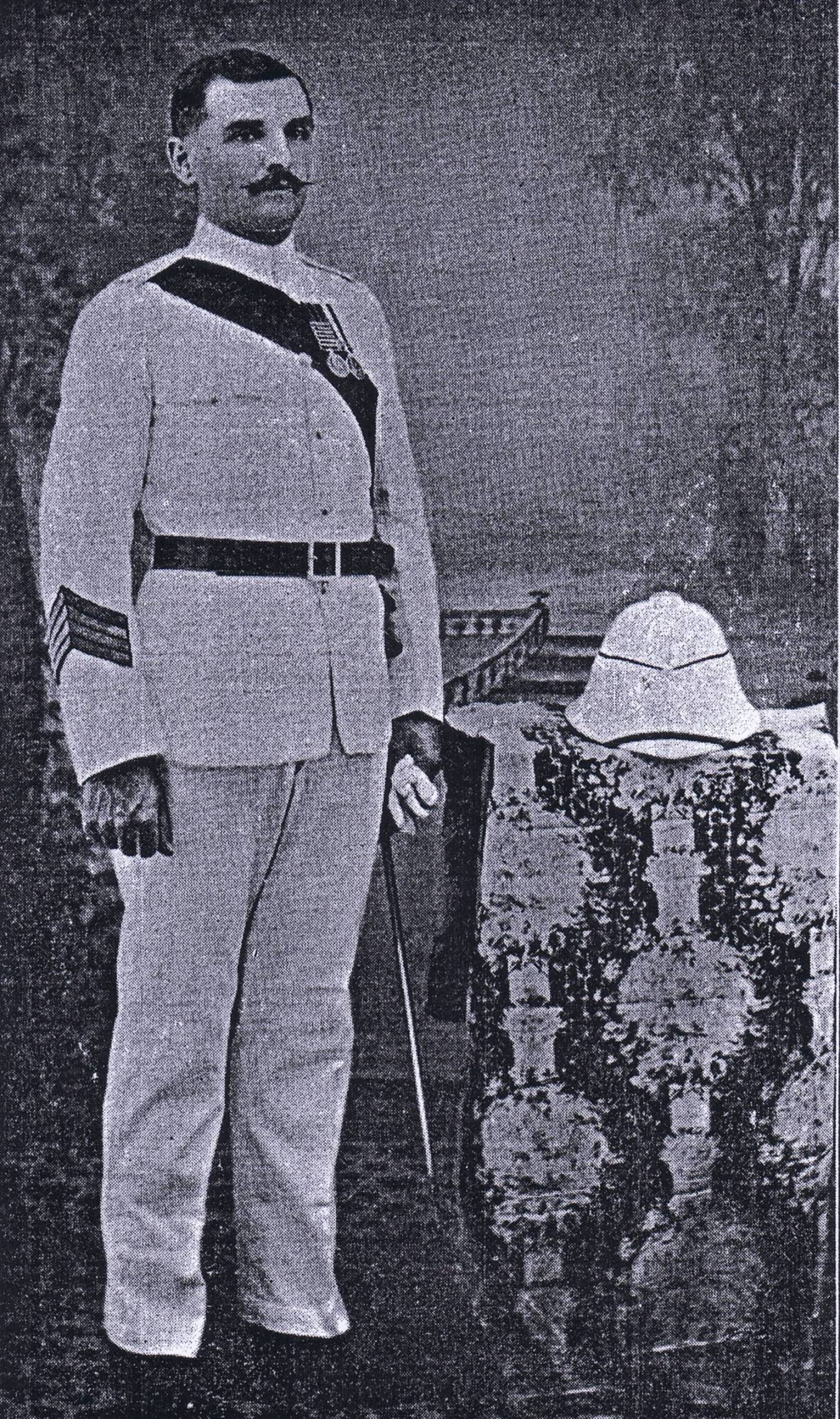
Born 27th of January 1880 Thomas was the son of Sergeant Valentine Goode also of the Yorkshire Regiment and his mother was called Helen. He was part of a large family; he had five brothers and two sisters.
He enlisted in Richmond on the 27th of August 1897. Being a first rate rifle shot he devoted himself to musketry and became an instructor. He served throughout the whole of the Boer War with the 1st Battalion. He was awarded the Queen’s medal with 6 clasps and the King’s with 2.
In 1905 he married Mary Agnes Grace Dobinson.
In 1914 he was with the 1st Battalion in India, his campaign medals indicate he was in France some time after 1915. He became a 2nd lieutenant in the Somerset Light Infantry (Prince Albert’s). He survived the war and retired with the rank of Captain on the 8th of June 1920.
He was awarded the M.B.E. on the 3rd of June 1919 for his services in connection with the war in India.
He must have returned to the army to serve in World War 2 because he has campaign medals (World War 2 service medal and war medal). Perhaps this might have been in some form of instructor role.
Explore more memories from the ribbon
-
Flora Sandes
Researched by John Mills. Flora Sandes was the only woman to officially fight on the front line during WW1, having joined the Serbian Army. Flora was born on the 26th January 1876 in Nether Poppleton, near York, the youngest of eight children. From an early age she exhibited an adventurous nature, a real tomboy, somewhat surprising for the daughter of a vicar! At the aged of 9 the family moved to rural Suffolk. Even her middle class upbringing didn’t dull her desire for adventure. After school she trained as a stenographer in London and scrapped together all her money, and together with the proceeds of a legacy from an uncle she went off to see the world travelling to places like Egypt, Canada and America. Flora was 38 years old when WW1 broke out and was living in London at the time. She enlisted as an Ambulance Service Volunteer and just 8 days later she was on her way to Serbia with the first volunteer unit to leave Britain. She worked in Military Hospitals and by October 1915 was fluent in the Serbian language. She eventually enlisted in the Serbian Army, one of the few countries in the world that accepted female soldiers. She soon made a name for herself, rising through the ranks to Sergeant within a year. It wasn’t just soldiering that Flora matched her male counterparts. She could hold her own racing cars, shooting, smoking and drinking. She survived the front line fighting, received a terrible shrapnel…
-
Henry Jesse Richardson
Paul Goad of Frenchgate told us about his Great-Uncle, Henry Jesse Richardson. Henry was born in March 1889 in Hailsham, East Sussex, where he lived prior to enlistment. In the 1911 census he gave his profession as Mat Making, his Father William, being a Mat Weaver at that time. Hailsham had a vibrant string, twine and rope based industry at the time from which they gained their employment. Henry enlisted in 1916 at Purfleet and joined the 13th London Regiment (Princess Louise’s Kensington Battalion). Henry’s Service medal and Award Rolls show that he served on the Western Front from September 1st 1916 until his death on August 16th 1917 at the Battle of Langemarck. During his time in theatre Henry’s Battalion were in action at the Battles of Ginchy, Flers-Courcelette and Morval in 1916 and the Second Battle of Arras in 1917. Henry’s burial spot is at Ypres, Arrondissement Ieper, West Flanders Belgium. He is also remembered on the roll of Hailsham War Memorial.
-
Ernest Pilcher
Peter Seaden-Jones visited us at a drop-in session at Richmond Station. From a photograph of his grandfather, we have managed to piece together the key details of Ernest John Pilcher’s war story. Ernest John Pilcher was born in Pietermaritzberg, Natal, South Africa in around 1881. According to the 1891 census, he appears to live in Chester as the 9 year old son of Frederick and Lucy Pilcher. He has a sister Edith and two brothers Archie and Arthur. His siblings are born in the U.K. but his father’s occupation as an Army Warrant Officer may explain Ernest’s birth in South Africa. On the 26th of December 1907 at the age of 26 he married Florence Alltimes at the Balham Hill Ascension church in Streatham. Florence was 23 years old at the time of their wedding. His occupation is recorded as a grocer. In the 1911 census Ernest and Florence were recorded as living at 23, Sussex street in Pimlico. He is listed as “Manager in the business of grocery stores”. Marjorie Edith their daughter was just 2 years old. At the age of 34 years and 6 months he enlisted in the army on the 22nd of November 1915. By this time his attestation record shows that he and Florence have a second daughter Peggy Dorothy born on the 6th of July 1913. Their address is now 20, Bellenden Road, Camberwell and his occupation is recorded as a “Traveller”. Although originally assigned to the Royal Field Artillery he transferred to…